
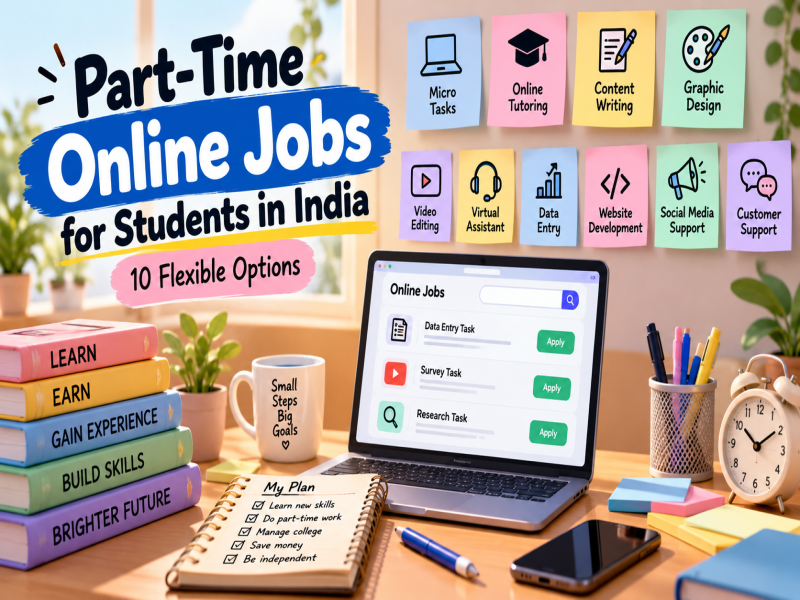
Are you a college student looking for part-time online jobs in India? Whether you want to manage your personal expenses, gain practical experience, or develop useful skills, online work can give you several options to explore alongside your studies.
Some opportunities involve completing small digital tasks, while others require specialised skills, regular working hours, or ongoing commitments. The right choice depends on your schedule, interests, experience, and income expectations.
In this guide, we'll explore 10 part-time online jobs for students, explain how they work, and share practical tips for finding legitimate opportunities.
Micro-task platforms offer small digital assignments that can often be completed individually. Depending on the platform, tasks may include data categorisation, online research, surveys, data entry, or other clearly defined activities.
Suitable for: Students who want to explore small tasks without committing to a traditional part-time schedule.
How to get started:
Find a platform with clear task instructions and payment policies.
Review the requirements before accepting a task.
Complete the assignment carefully and submit the required evidence.
Check the approval and withdrawal conditions.
SnapGig is a micro-task marketplace where businesses can post digital tasks for users to complete. Students can visit SnapGig to learn about the platform and review the available opportunities and eligibility requirements.
Remember that task availability and rewards can vary. Micro-task platforms do not guarantee a particular income.
If you understand a subject well, online tutoring can be a way to share your knowledge with school students or other learners.
Subjects may include mathematics, science, English, accounting, programming, or other areas in which you have sufficient knowledge.
Suitable for: Students who are confident in a subject and can explain concepts clearly.
How to get started:
Choose the subjects and academic levels you can teach.
Prepare sample explanations or practice lessons.
Explore legitimate tutoring platforms or find clients through appropriate networks.
Agree on session timings, payment terms, and cancellation policies.
Tutoring may require scheduled sessions, so choose hours that do not interfere with your classes or examinations.
Businesses often need website articles, product descriptions, blog posts, newsletters, and other written content.
Students with good writing and research skills can build a portfolio and explore freelance assignments.
Suitable for: Students who enjoy writing and are willing to research topics carefully.
How to get started:
Practise writing clear, original articles.
Create two or three relevant writing samples.
Learn basic formatting, editing, and fact-checking.
Apply for suitable projects and agree on the scope before beginning.
Do not copy existing articles or submit unverified information. Originality and accuracy are important for building a professional reputation.
Graphic designers create visual material such as social media posts, posters, presentations, advertisements, and promotional graphics.
Students can begin with basic design tools and gradually develop more advanced skills.
Suitable for: Students interested in visual communication and creative work.
How to get started:
Learn a design tool such as Canva or another suitable application.
Create sample designs for different purposes.
Organise your best work into a portfolio.
Look for small projects with clear deliverables and deadlines.
Focus on learning layout, typography, visual hierarchy, and consistency rather than relying only on templates.
Creators, businesses, and marketing teams may need help editing short videos, educational content, interviews, or promotional material.
Suitable for: Students interested in video, storytelling, and digital content.
How to get started:
Learn a video-editing application.
Practise trimming footage, adding captions, balancing audio, and creating transitions.
Produce sample videos that demonstrate your skills.
Agree on video length, revisions, delivery format, and deadlines before accepting a project.
Video editing can require significant practice and may involve longer assignments than micro-tasks.
Virtual assistants help businesses or independent professionals with administrative activities.
Responsibilities may include organising spreadsheets, scheduling appointments, maintaining records, preparing documents, or managing routine communications.
Suitable for: Students who are organised, reliable, and comfortable with basic office tools.
How to get started:
Practise using spreadsheets, documents, calendars, and email.
Identify the administrative tasks you can handle confidently.
Look for legitimate remote assistant roles.
Clarify working hours, responsibilities, access permissions, and payment arrangements.
Some virtual assistant roles require regular availability, so check the schedule carefully before accepting an opportunity.
Data-entry work involves transferring, updating, checking, or organising information in digital systems.
Tasks may involve spreadsheets, product catalogues, records, or other structured information.
Suitable for: Students with good attention to detail and basic computer skills.
How to get started:
Practise spreadsheet formatting and accurate data entry.
Learn basic sorting, filtering, and data validation.
Check that a job provider is legitimate.
Confirm the workload, accuracy requirements, deadlines, and payment terms.
Be particularly careful with data-entry offers that demand registration fees or promise unusually high earnings for very little work.
Students who know HTML, CSS, JavaScript, WordPress, or other web technologies can explore small website projects.
Examples include updating website content, fixing layout issues, building landing pages, or creating simple business websites.
Suitable for: Students who enjoy technology and problem-solving.
How to get started:
Build sample projects to demonstrate your abilities.
Create a portfolio showing what you built and the technologies used.
Start with clearly defined projects that match your current skill level.
Use written agreements covering scope, revisions, access, deadlines, and payment.
Website development can provide valuable portfolio experience, but learning the fundamentals takes time.
Small businesses may need help preparing content calendars, scheduling posts, designing simple creatives, or reviewing social media performance.
Suitable for: Students interested in digital marketing and online communication.
How to get started:
Learn content planning and basic platform analytics.
Practise preparing a weekly content calendar.
Create sample posts for a hypothetical business.
Approach legitimate clients with a clear description of the services you can provide.
Do not accept assignments that require fake reviews, deceptive engagement, spam, or violations of platform rules.
Some companies offer remote customer-support roles involving email, chat, or telephone communication.
Responsibilities can include answering customer questions, documenting issues, and helping users navigate products or services.
Suitable for: Students with good communication skills and reliable internet access.
How to get started:
Improve written communication and problem-solving.
Prepare a basic resume highlighting relevant skills.
Search for genuine entry-level remote vacancies.
Check shift timings, language requirements, training, and employment terms.
Customer-support jobs often have fixed shifts and may not be as flexible as task-based work.
The best option depends on what you need and how much time you can commit.
| Your priority | Options to explore |
|---|---|
| Small, individual assignments | Micro-task platforms |
| Using academic knowledge | Online tutoring |
| Developing a creative portfolio | Writing, graphic design, video editing |
| Building technical skills | Website development |
| Organised administrative work | Data entry, virtual assistance |
| Exploring digital marketing | Social media assistance |
| More structured remote employment | Customer support |
If you are new to online work, begin with one or two options instead of trying everything at once. Evaluate the time required, learning curve, eligibility conditions, and payment terms.
There is no single reliable income figure for all online jobs.
Earnings vary according to the type of work, skill level, client demand, hours available, and payment arrangement. Freelancers may earn differently from employees, and micro-task availability can fluctuate.
Before accepting work, consider:
The stated payment or reward.
The amount of time needed to finish the assignment.
Whether revisions or additional tasks are expected.
Payment processing fees, if any.
The conditions for approval and payment.
Calculate the likely return on your time rather than relying on income claims advertised online. Never treat an unverified earning estimate as a guarantee.
Students searching for part-time online jobs should verify opportunities before sharing personal information or investing time.
Be cautious of upfront fees. A demand for payment to unlock promised earnings is a warning sign.
Avoid guaranteed-income promises. Claims of high income for almost no work deserve careful scrutiny.
Verify the organisation. Check its official website, contact information, terms, and independent reputation.
Protect your accounts. Never share passwords, one-time passcodes, or banking credentials with recruiters or task providers.
Read the terms. Understand the workload, eligibility criteria, payment method, deadlines, and approval process.
Reject deceptive work. Avoid assignments involving fake reviews, fraudulent registrations, spam, or misleading activity.
If an opportunity seems suspicious, do not proceed until you have verified it.
Online work should support your goals, not undermine your education.
Set a realistic weekly time limit.
Choose work that fits around classes and examinations.
Keep track of deadlines and assignments.
Start with a manageable workload.
Build skills that remain useful beyond a single task.
Review whether the time spent is worthwhile.
Stop accepting new assignments when your schedule becomes unmanageable.
Consistency, communication, and reliable delivery are useful professional habits regardless of the type of work you choose.
SnapGig is a micro-task marketplace designed to connect businesses posting digital tasks with people completing those tasks.
If you're interested in exploring task-based online work, visit SnapGig to learn how the platform operates and review the tasks, eligibility requirements, and payment conditions available to you.
Read each task's instructions before participating, and only accept assignments you can complete accurately and legitimately.
Visit SnapGig: https://snapgig.in/
Micro-tasks, basic data entry, and some beginner-friendly freelance assignments may be accessible, depending on eligibility and the requirements of each opportunity. Start with tasks you understand and build your skills gradually.
Yes. College students can explore suitable online work, provided they meet the relevant eligibility requirements and can manage the commitment alongside their studies.
Some micro-tasks and online assignments can be completed on a phone. Other work, such as website development, extensive data entry, or video editing, may require a computer.
No. Freelance projects and micro-tasks may offer more control over when work is completed, while customer support and virtual assistant positions may require fixed hours.
Be cautious of opportunities that require deposits or payments to unlock promised earnings. Verify the organisation and its terms before paying for any legitimate service or training.
SnapGig is a micro-task marketplace. Students should review the available tasks, eligibility requirements, and applicable payment conditions to determine whether the platform suits their needs.
Part-time online work can help students explore practical skills, gain experience, and potentially earn money while studying. Options range from individual micro-tasks to specialised freelance projects and structured remote employment.
Choose opportunities based on your skills, available time, and realistic expectations. Verify the platform, understand the payment terms, and prioritise legitimate work.
Start with a manageable commitment, learn from each assignment, and gradually develop skills that can support your longer-term career goals.
Create your free account, complete verified tasks, submit proof, and earn real rewards securely.